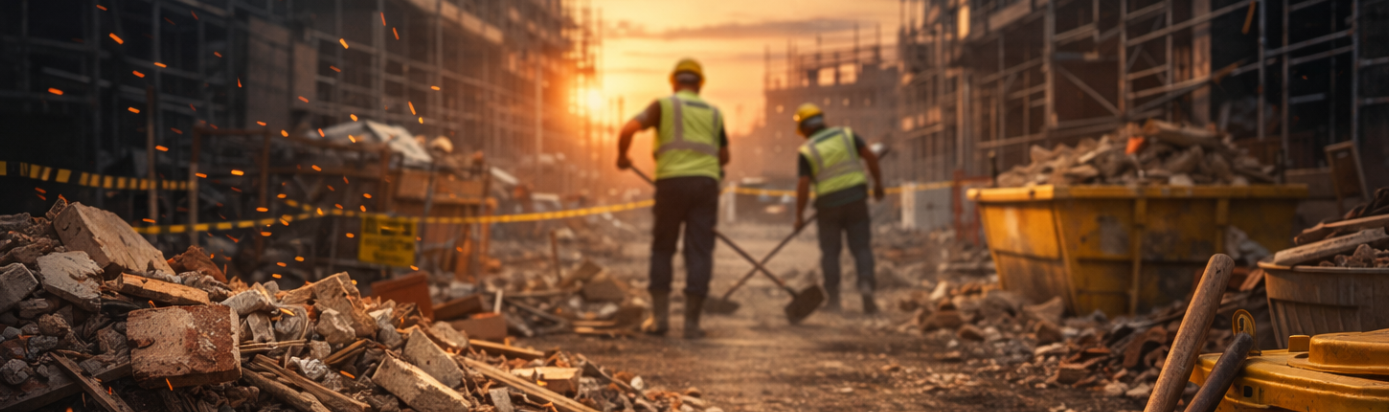
What the Law Actually Says – Construction Regulation 27
Construction Regulation 27 states:
“A contractor must… ensure that suitable housekeeping is continuously implemented on each construction site…”
The wording is deliberate.
The regulation does not require occasional clean-ups or reactive action, it requires continuous implementation.
The regulation then goes further and defines what proper housekeeping actually includes:
- Proper storage of materials and equipment
- Removal of scrap, waste, and debris at appropriate intervals
- Ensuring that materials do not obstruct access and egress
- Preventing accumulation of unused materials
- Safe disposal of waste from height
- Protecting the public through fencing and controlled access
- Protecting persons from falling objects
This is not a general statement, it is a structured system of control.
Housekeeping Is Not About Cleanliness, It’s About Risk Control
The biggest misunderstanding on site is that housekeeping is about keeping things neat.
It is not.
Housekeeping is about controlling hazards before they become incidents.
Every item left in the wrong place, every pile of waste not removed, and every blocked walkway contributes to a loss of control on site.
And construction sites do not become unsafe overnight,
they become unsafe through small failures that are not corrected.
Proper Storage: The First Point of Failure
The regulation requires:
“The proper storage of materials and equipment”
This is often where poor housekeeping begins.
Materials are stacked where there is space instead of where it is safe. Tools are left where they were last used. Equipment is stored in access routes because it is convenient.
Over time, this creates:
- Trip hazards
- Unstable stacking
- Obstructed movement
Proper storage ensures that materials are:
- Stable
- Organised
- Positioned away from walkways and work areas
It is one of the simplest controls, and one of the most overlooked.
Waste and Debris: A Clear Sign of Non-Compliance
Construction Regulation 27 requires:
“The removal of scrap, waste and debris at appropriate intervals”
and
“Materials… no longer required… do not accumulate on site”
Waste is not just a housekeeping issue, it is a risk multiplier.
When waste is not removed:
- Walkways become obstructed
- Fire load increases
- Work areas become restricted
A well-managed site removes waste continuously, not at the end of the week or when it becomes excessive.
If waste is building up, it is a clear indication that housekeeping is not being controlled.
Access and Egress: Critical for Safety
The regulation specifically states that materials must not:
“Obstruct means of access to and egress from workplaces and passageways”
This is one of the most important, and most frequently ignored, requirements.
On many sites:
- Materials are placed in corridors
- Cables run across walkways
- Debris blocks exit routes
In normal conditions, this creates trip hazards.
In emergency situations, it can delay evacuation and response, increasing the severity of incidents.
Access routes must remain clear, defined, and unobstructed at all times.
Working at Height: Controlling Falling Objects
The regulation also requires protection where work is done above people:
“A catch platform or net… or fencing off the danger area…”
This applies whenever work is carried out above:
- Entrances
- Passageways
- Active work areas
Falling objects are a predictable hazard in construction.
Tools, materials, or debris dropped from height can cause serious or fatal injuries.
If there is no protection in place, the risk is not being managed,
and the site is non-compliant.
Public Protection: Extending Beyond the Site
Construction Regulation 27 also places a duty on contractors to protect the public:
“Construction sites in built-up areas… are suitably and sufficiently fenced off and provided with controlled access points…”
This is often overlooked, especially on smaller projects.
If your site is open to:
- Pedestrians
- Members of the public
- Unauthorised persons
Then your risk extends beyond your workforce.
Public access introduces:
- Injury risk
- Legal liability
- Immediate enforcement action
A construction site must be secured and controlled, regardless of size.
Housekeeping Is a Continuous System
The most important word in Construction Regulation 27 is “continuously.”
Housekeeping cannot be:
- Once-off
- End-of-day
- Reactionary
It must be part of the daily operation of the site.
This means:
- Supervisors must enforce it
- Workers must maintain it
- Management must monitor it
It is also reinforced by the Occupational Health and Safety Act:
- OSH Act Section 8 – Employers must provide a safe working environment
- OSH Act Section 14 – Employees must take reasonable care and follow safety rules
Housekeeping is therefore a shared legal responsibility.
Why Inspectors Focus on Housekeeping First
When inspectors arrive on site, housekeeping is one of the first things they assess.
Not because it is minor, but because it reflects the overall level of control.
A site with poor housekeeping usually indicates:
- Weak supervision
- Poor planning
- Lack of compliance systems
A well-managed site shows control immediately through:
- Clear access routes
- Controlled storage
- Clean, organised work areas
Housekeeping is often the first visible sign of compliance, or the lack of it.
How Zenith Safety Consultants (ZSC) Can Assist
At Zenith Safety Consultants (ZSC), we understand that housekeeping is more than just keeping a site clean, it is about maintaining control, safety, and legal compliance.
We assist contractors by:
- Conducting site inspections and compliance audits
- Providing practical solutions that are workable on real sites
Our focus is simple:
Turn compliance into something practical, enforceable, and effective
Housekeeping is one of the most underestimated aspects of construction safety.
But under Construction Regulation 27, it is not optional,
it is a legal requirement that directly impacts safety and compliance.
If your site relies on:
- Occasional clean-ups
- Verbal instructions
- Reactive fixes
Then you do not have a housekeeping system.
And without a system, you do not have control.
ZSC helps you integrate safety into your project design, ensuring that all regulatory requirements are met, and your project proceeds without safety concerns. Contact us to learn how we can make your project safer and compliant from start to finish on 021 010 0209 or This email address is being protected from spambots. You need JavaScript enabled to view it.

 Talk to us!