
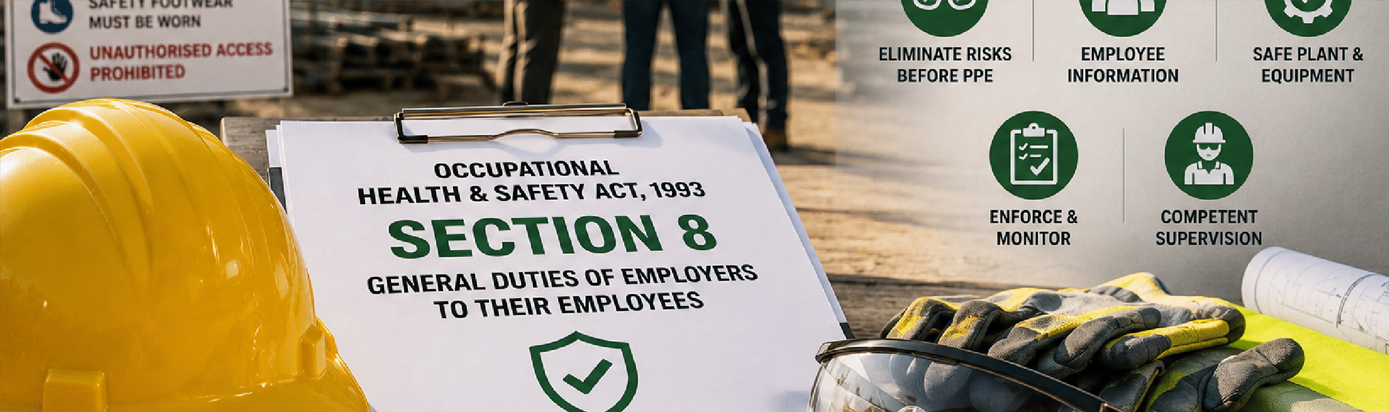
OSH Act 8: General duties of employers to their employees
OHS Act Section 8: The Most Important Duty an Employer Has
If there is one section of the Occupational Health and Safety Act that every employer, manager, supervisor, and business owner should understand, it is Section 8.
Many people think health and safety compliance begins with PPE, safety files, inspections, or legal appointments. In reality, all of these requirements stem from a much broader legal obligation imposed on employers by Section 8 of the Occupational Health and Safety Act 85 of 1993.
This section establishes the fundamental duty of every employer in South Africa:
"Every employer shall provide and maintain, as far as is reasonably practicable, a working environment that is safe and without risk to the health of his employees."
Everything else in the Act flows from this requirement.
Whether you operate a construction company, manufacturing facility, warehouse, engineering workshop, office, or retail operation, Section 8 places a legal responsibility on employers to actively manage workplace health and safety.
The key phrase within the section is "as far as is reasonably practicable."
This does not mean employers must eliminate every conceivable risk. Instead, it requires employers to take all reasonable steps to identify hazards, assess risks, implement controls, and protect employees from foreseeable harm.
In simple terms, if a hazard is known and a reasonable control measure exists, the employer is expected to implement it.
|
Section 8 Is More Than a General Duty Many people read Section 8(1) and assume it is simply a broad statement of intent. However, Section 8(2) expands significantly on what this duty actually means in practice. The Act specifically identifies several areas where employers must take action to ensure workplace health and safety. These obligations form the foundation of every effective safety management system. Safe Systems of Work, Plant and Machinery Section 8(2)(a) requires employers to provide and maintain systems of work, plant, and machinery that are safe and without risks to health. This means safety is not limited to equipment alone. A machine may be perfectly designed, but if employees are not trained to use it correctly, or if maintenance is neglected, the system is no longer safe. Similarly, a work process may create hazards even when the equipment itself is functioning properly. Employers must therefore consider the entire system, including:
A safe workplace is built on safe systems, not just safe equipment. Eliminate Hazards Before Relying on PPE One of the most important principles contained in Section 8 appears in subsection (2)(b). The Act requires employers to eliminate or mitigate hazards before resorting to personal protective equipment. This is the legal foundation of what we now refer to as the Hierarchy of Controls. Far too often, companies attempt to solve every problem with PPE. Workers are given hard hats, gloves, goggles, and harnesses while the underlying hazard remains unchanged. The law requires a different approach. Employers must first ask:
Only once these options have been considered should PPE be relied upon as a final layer of protection. This is why PPE should never be viewed as a safety system on its own. Hazard Identification and Risk Assessment Section 8(2)(d) requires employers to establish what hazards exist within their operations and determine what precautionary measures are necessary to protect employees. This requirement forms the legal basis for risk assessments. Before risks can be controlled, they must first be identified. Employers must understand:
This process cannot be a once-off exercise. As workplaces change, risks change. New equipment, new materials, new processes, new employees, and new work environments all introduce new hazards that must be assessed and managed. This is why risk assessments remain one of the most important tools in occupational health and safety. Information, Instruction, Training and Supervision One of the most overlooked requirements of Section 8 is found in subsection (2)(e). Employers must provide the information, instruction, training, and supervision necessary to ensure employee health and safety. Many incidents occur not because employees intentionally work unsafely, but because they were never properly informed of the risks. Training should not be viewed as a compliance exercise. It is one of the primary methods through which employers discharge their legal duties. This includes:
Training creates awareness, but supervision ensures that safe practices are actually followed. The law requires both. No Work Should Begin Until Controls Are in Place Section 8(2)(f) contains a particularly important requirement. Employers may not permit employees to perform work, operate machinery, handle substances, or undertake activities unless the necessary precautionary measures have been implemented. This means work should not begin first and safety be addressed later. The controls must already be in place before exposure occurs. This principle is particularly relevant to:
If the required controls have not been implemented, the work should not proceed. Enforcement Is an Employer Responsibility Health and safety rules are meaningless if they are not enforced. Section 8(2)(g) and (h) require employers not only to establish safety measures but also to ensure that employees comply with them. This means employers must:
Too many organisations have excellent procedures that exist only on paper. Compliance requires implementation and enforcement. Competent Supervision Matters Section 8(2)(i) requires work to be performed under the supervision of a person who understands the hazards associated with the work and who has the authority to ensure that control measures are implemented. This requirement recognises a simple reality: Safety systems often succeed or fail at supervisory level. Supervisors bridge the gap between management expectations and worksite activities. Without competent supervision, even the best policies, procedures, and risk assessments can fail. Why Section 8 Is the Foundation of Workplace Safety When you examine almost every requirement contained within the Occupational Health and Safety Act, you will find that it ultimately supports the duties imposed by Section 8. Risk assessments. All of these exist because employers have a legal duty to provide and maintain a workplace that is safe and without risk to health. Section 8 is therefore not simply another section of the Act. It is the foundation upon which workplace health and safety is built. How Zenith Safety Consultants Can Assist At Zenith Safety Consultants (ZSC), we assist organisations in translating the legal requirements of Section 8 into practical workplace systems. Our services include:
Compliance with Section 8 is not achieved through paperwork alone. It requires systems, leadership, supervision, and continuous improvement. Final Thoughts Section 8 places a clear responsibility on employers: provide and maintain a workplace that is safe and without risk to health as far as is reasonably practicable. This responsibility cannot be delegated away, ignored, or treated as a box-ticking exercise. The most successful organisations understand that health and safety is not merely a legal requirement—it is a management responsibility that directly impacts people, productivity, reputation, and business success. When employers fully understand and implement the requirements of Section 8, compliance becomes more than a legal obligation. It becomes part of how the organisation operates every day. For more information on how Zenith Safety Consultants can help your business, please contact us at This email address is being protected from spambots. You need JavaScript enabled to view it. or call 021 010 0209. |

 Talk to us!
